Technology
AI Agents are Learning to Handle Real-World Products. This Startup is Building the Infrastructure
AI Agents are Learning to Handle Real-World Products. This Startup is Building the Infrastructure

Pentatonic is building the commerce layer that lets AI see, value and transact on physical goods, starting with the $30 trillion of products sitting in consumers’ homes.
Decades ago, local dairies participated in the first version of agentic commerce, even if they didn’t call it that. The milkman was the original commerce agent: He could track your consumption by the empty milk bottles on your doorstep, knew what you needed, priced it on the spot and closed the transaction before you’d finished breakfast. Brand loyalty and the opportunity to upsell (think cream, butter, cheese) was inherent in the process. The milkman had product intelligence.
London-based startup Pentatonic is building the AI-powered version of that idea at a global scale. The company has developed what it calls the data layer for agentic consumer commerce: infrastructure that gives AI agents the ability to identify, value and facilitate transactions on physical products in real time, co-founder Johann Boedecker says. Think of it as the missing API for stuff. And it’s arriving at exactly the moment that AI-native commerce is exploding.
Pentatonic wants to make it easier for both consumers and retailers to tap into that estimated $30 trillion in products sitting in consumers’ homes and warehouses: goods that today’s AI systems simply cannot see, understand or transact on. Pentatonic’s cloud platform combines computer vision and real-time payment rails to turn every one of those products into a live commerce opportunity for brands. Underpinning this is the Thing Event System (TES), an event-driven governance layer that captures and verifies every agent-initiated transaction in real time, giving brands and platforms a transparent, verifiable record you can trust, and observability and traceability at scale.

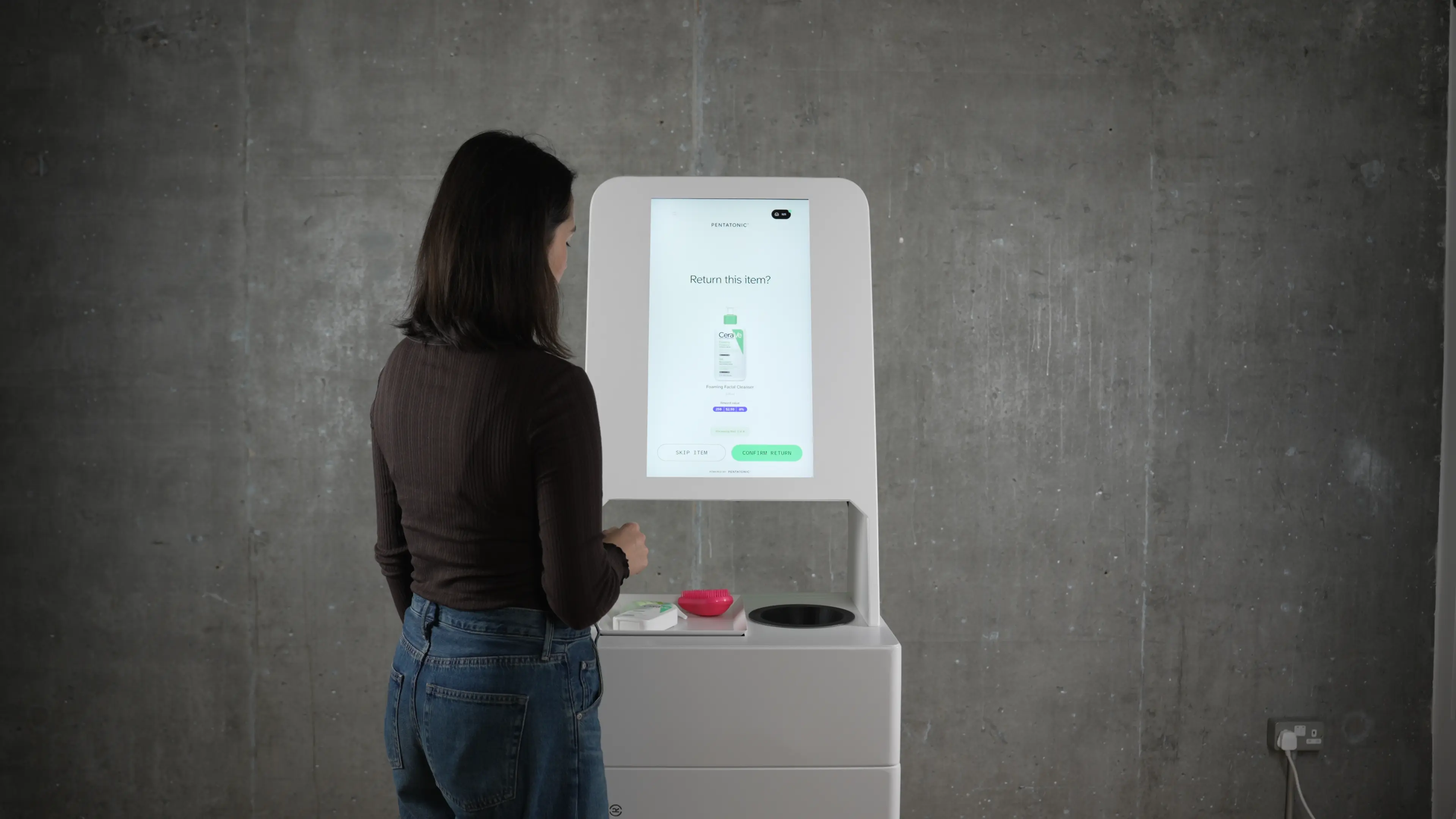
Trade‑in rewards redeemed through Pentatonic’s system have been shown to increase in‑store basket sizes by about 30%, according to the company. (Photo courtesy of Pentatonic)
Here’s how it works: A consumer points their phone at a product or places it on one of Pentatonic’s in-store devices. The AI identifies the item, assesses its condition, pulls real-time market data and makes an instant offer, all in seconds. Accept, and you’re paid digitally. Behind the scenes, the AI routes the product to its highest-value next destination: resale, refurbishment, refill or recycling. Every interaction generates structured data that flows back to the brand: what consumers have owned, when they’re ready to trade, what they want next. It’s the AI-powered milkman, except now it can access every product in the house, Boedecker says.
“We built the infrastructure that lets AI agents handle physical products the way they already handle digital ones,” he says. “Every product a brand has ever sold is an opportunity for a new transaction, a new insight, a new relationship. We make that possible.”
The circular economy, meet AI
The rise in AI-powered commerce coincides with changing consumer priorities, with research pointing to increased interest in secondhand commerce and more circular ways of buying and selling. Nearly half of Gen Z and millennial shoppers say they look first for used items, compared to about a quarter of Boomers, according to Mastercard’s November 2025 Consumer Collective Economic Pulse survey.
That shift isn’t just about sustainability — it’s a structural change in how commerce works. Secondhand clothing and accessories alone represented a $220 billion market in 2025, expected to reach $360 billion by 2030, according to BCG. But the real prize is bigger: Globally, the secondary market in fashion retail is expanding five times faster than traditional retail, according to ThredUp’s report on resale in 2025
“People want to contribute in a positive way to the environment, but the system doesn’t always make that easy,” said Ellen Jackowski, Mastercard’s chief sustainability officer. “When the more affordable and more accessible choice also happens to be the more sustainable choice, that’s when you start seeing the market move toward a new, regenerative economy.”
To help turn that demand into action, Mastercard last year welcomed a subset of startups dedicated to advancing circular commerce to its award-winning Start Path startup engagement program, including Pentatonic.
With an acceptance network of more than 150 million merchants and billions of cards in circulation, Mastercard is also piloting innovations such as card-linked rewards that encourage reuse in high-traffic settings like university campuses as well as digitized return-deposit schemes with cities and tourist destinations that reduce single use waste and enable near instant refunds via Mastercard Move, the company’s portfolio of money movement solutions, making sustainable choices easier. Pentatonic leverages Mastercard Move to enable near-instant payments that make secondary commerce as frictionless as buying new.
Building the secondhand infrastructure
A millennial himself, Boedecker spent a decade building consumer product supply chains across companies in Taiwan and China. Over time, he saw that brands were generating enormous amounts of product data and consumer data after the point of sale but had no infrastructure to capture or act on it. Returns, trade-ins, repairs and resale were all handled by disconnected manual processes. He saw a gap: The same AI revolution transforming digital commerce had no equivalent layer for physical products.
“You can’t make life more expensive for the end consumer to be more sustainable,” Boedecker says.
So, in 2019, he and two partners launched Pentatonic, which also has operations in San Francisco, to help companies build AI-powered commerce infrastructure that creates new revenue from products brands have already sold. The platform handles the full lifecycle: identification, valuation, transaction, routing and analytics.
Every product becomes a data point and an additional transaction
About a quarter of millennials and Gen Z consumers say environmental impact is a factor when deciding to buy, according to Mastercard’s survey. But the commercial case is even more compelling. Boedecker argues that AI-powered commerce infrastructure creates an entirely new capture point for revenue and first-party data — one that didn’t exist before because brands had no way to maintain a relationship with products after the first sale.
In areas with physical stores, 85% of nearby customers choose to return items in person, he says. Each of those visits is an opportunity to scan, value, upsell and gather structured product intelligence that feeds back into the brand’s commerce and marketing systems.
In early 2026, Pentatonic introduced its Physical Intelligence Node, or PIN, an edge AI device that brings computer vision and agentic commerce directly into retail stores. The PIN combines cameras, sensors and on-device AI models capable of identifying, grading and valuing multiple products simultaneously, then executing transactions in real time.
Products routed through Pentatonic’s system are sorted for resale, refurbishment or recycling — part of the company’s vision for AI-enabled circular commerce. (Photo courtesy of Pentatonic)
A customer can place a product or empty packaging on the device and receive an AI-generated valuation and instant payment. But the PIN is more than a transaction point —it’s a product intelligence endpoint. With customer consent, it captures structured data about what consumers own from that brand, how products have performed and what they want next.
“You have an AI doing an exit interview with your consumers,” Boedecker said. For example, a shopper returning empty skincare bottles could indicate that a formula felt too oily or didn’t contain strong enough sun protection. The system logs that feedback and recommends better alternatives, which can increase basket sizes and boost customer loyalty. During an in-person pilot, Pentatonic reported that checkout basket values rose about 30% when customers redeemed trade-in rewards on the spot, proof that agentic commerce drives immediate, measurable revenue uplift.
Real-time commerce cycles
Already in use by more than 150 brands across electronics, sportswear, toys and beauty, Pentatonic’s platform processes millions of API requests and manages a product knowledge graph spanning tens of millions of items. The commercial results are compelling on their own, but there’s a sustainability dividend, too: Products resold through Pentatonic’s system generate a 70% reduction in average CO₂ emissions compared to newly manufactured goods, the company says.
The vision is bigger than resale alone. Boedecker sees Pentatonic’s infrastructure as the layer that lets any AI agent, whether it’s a brand’s own system or a third-party assistant, transact on physical products with the same ease that software agents already book flights or trade stocks. “Brands that build this infrastructure now will own the relationship with their products and their customers for decades,” he says. “The ones that don’t will watch AI agents route that value to someone else.
Pentatonic is building the commerce layer that lets AI see, value and transact on physical goods, starting with the $30 trillion of products sitting in consumers’ homes.
Decades ago, local dairies participated in the first version of agentic commerce, even if they didn’t call it that. The milkman was the original commerce agent: He could track your consumption by the empty milk bottles on your doorstep, knew what you needed, priced it on the spot and closed the transaction before you’d finished breakfast. Brand loyalty and the opportunity to upsell (think cream, butter, cheese) was inherent in the process. The milkman had product intelligence.
London-based startup Pentatonic is building the AI-powered version of that idea at a global scale. The company has developed what it calls the data layer for agentic consumer commerce: infrastructure that gives AI agents the ability to identify, value and facilitate transactions on physical products in real time, co-founder Johann Boedecker says. Think of it as the missing API for stuff. And it’s arriving at exactly the moment that AI-native commerce is exploding.
Pentatonic wants to make it easier for both consumers and retailers to tap into that estimated $30 trillion in products sitting in consumers’ homes and warehouses: goods that today’s AI systems simply cannot see, understand or transact on. Pentatonic’s cloud platform combines computer vision and real-time payment rails to turn every one of those products into a live commerce opportunity for brands. Underpinning this is the Thing Event System (TES), an event-driven governance layer that captures and verifies every agent-initiated transaction in real time, giving brands and platforms a transparent, verifiable record you can trust, and observability and traceability at scale.
Trade‑in rewards redeemed through Pentatonic’s system have been shown to increase in‑store basket sizes by about 30%, according to the company. (Photo courtesy of Pentatonic)
Here’s how it works: A consumer points their phone at a product or places it on one of Pentatonic’s in-store devices. The AI identifies the item, assesses its condition, pulls real-time market data and makes an instant offer, all in seconds. Accept, and you’re paid digitally. Behind the scenes, the AI routes the product to its highest-value next destination: resale, refurbishment, refill or recycling. Every interaction generates structured data that flows back to the brand: what consumers have owned, when they’re ready to trade, what they want next. It’s the AI-powered milkman, except now it can access every product in the house, Boedecker says.
“We built the infrastructure that lets AI agents handle physical products the way they already handle digital ones,” he says. “Every product a brand has ever sold is an opportunity for a new transaction, a new insight, a new relationship. We make that possible.”
The circular economy, meet AI
The rise in AI-powered commerce coincides with changing consumer priorities, with research pointing to increased interest in secondhand commerce and more circular ways of buying and selling. Nearly half of Gen Z and millennial shoppers say they look first for used items, compared to about a quarter of Boomers, according to Mastercard’s November 2025 Consumer Collective Economic Pulse survey.
That shift isn’t just about sustainability — it’s a structural change in how commerce works. Secondhand clothing and accessories alone represented a $220 billion market in 2025, expected to reach $360 billion by 2030, according to BCG. But the real prize is bigger: Globally, the secondary market in fashion retail is expanding five times faster than traditional retail, according to ThredUp’s report on resale in 2025
“People want to contribute in a positive way to the environment, but the system doesn’t always make that easy,” said Ellen Jackowski, Mastercard’s chief sustainability officer. “When the more affordable and more accessible choice also happens to be the more sustainable choice, that’s when you start seeing the market move toward a new, regenerative economy.”
To help turn that demand into action, Mastercard last year welcomed a subset of startups dedicated to advancing circular commerce to its award-winning Start Path startup engagement program, including Pentatonic.
With an acceptance network of more than 150 million merchants and billions of cards in circulation, Mastercard is also piloting innovations such as card-linked rewards that encourage reuse in high-traffic settings like university campuses as well as digitized return-deposit schemes with cities and tourist destinations that reduce single use waste and enable near instant refunds via Mastercard Move, the company’s portfolio of money movement solutions, making sustainable choices easier. Pentatonic leverages Mastercard Move to enable near-instant payments that make secondary commerce as frictionless as buying new.
Building the secondhand infrastructure
A millennial himself, Boedecker spent a decade building consumer product supply chains across companies in Taiwan and China. Over time, he saw that brands were generating enormous amounts of product data and consumer data after the point of sale but had no infrastructure to capture or act on it. Returns, trade-ins, repairs and resale were all handled by disconnected manual processes. He saw a gap: The same AI revolution transforming digital commerce had no equivalent layer for physical products.
“You can’t make life more expensive for the end consumer to be more sustainable,” Boedecker says.
So, in 2019, he and two partners launched Pentatonic, which also has operations in San Francisco, to help companies build AI-powered commerce infrastructure that creates new revenue from products brands have already sold. The platform handles the full lifecycle: identification, valuation, transaction, routing and analytics.
Every product becomes a data point and an additional transaction
About a quarter of millennials and Gen Z consumers say environmental impact is a factor when deciding to buy, according to Mastercard’s survey. But the commercial case is even more compelling. Boedecker argues that AI-powered commerce infrastructure creates an entirely new capture point for revenue and first-party data — one that didn’t exist before because brands had no way to maintain a relationship with products after the first sale.
In areas with physical stores, 85% of nearby customers choose to return items in person, he says. Each of those visits is an opportunity to scan, value, upsell and gather structured product intelligence that feeds back into the brand’s commerce and marketing systems.
In early 2026, Pentatonic introduced its Physical Intelligence Node, or PIN, an edge AI device that brings computer vision and agentic commerce directly into retail stores. The PIN combines cameras, sensors and on-device AI models capable of identifying, grading and valuing multiple products simultaneously, then executing transactions in real time.
Products routed through Pentatonic’s system are sorted for resale, refurbishment or recycling — part of the company’s vision for AI-enabled circular commerce. (Photo courtesy of Pentatonic)
A customer can place a product or empty packaging on the device and receive an AI-generated valuation and instant payment. But the PIN is more than a transaction point —it’s a product intelligence endpoint. With customer consent, it captures structured data about what consumers own from that brand, how products have performed and what they want next.
“You have an AI doing an exit interview with your consumers,” Boedecker said. For example, a shopper returning empty skincare bottles could indicate that a formula felt too oily or didn’t contain strong enough sun protection. The system logs that feedback and recommends better alternatives, which can increase basket sizes and boost customer loyalty. During an in-person pilot, Pentatonic reported that checkout basket values rose about 30% when customers redeemed trade-in rewards on the spot, proof that agentic commerce drives immediate, measurable revenue uplift.
Real-time commerce cycles
Already in use by more than 150 brands across electronics, sportswear, toys and beauty, Pentatonic’s platform processes millions of API requests and manages a product knowledge graph spanning tens of millions of items. The commercial results are compelling on their own, but there’s a sustainability dividend, too: Products resold through Pentatonic’s system generate a 70% reduction in average CO₂ emissions compared to newly manufactured goods, the company says.
The vision is bigger than resale alone. Boedecker sees Pentatonic’s infrastructure as the layer that lets any AI agent, whether it’s a brand’s own system or a third-party assistant, transact on physical products with the same ease that software agents already book flights or trade stocks. “Brands that build this infrastructure now will own the relationship with their products and their customers for decades,” he says. “The ones that don’t will watch AI agents route that value to someone else.
About the author

Johann Boedecker is the founder and CEO of Pentatonic, an AI platform that automates trade-in programs and agentic commerce. Prior to founding Pentatonic, Johann garnered a decade of manufacturing and supply-chain experience across Taiwan and China, and published on materials science and industrial systems.

We’d love to show you exactly how our multi-commerce system works.
BOOK A DEMO
We’d love to show you exactly how our multi-commerce system works.
BOOK A DEMO
27 Downham Road Units 5–6
London, N1 5AA
UK
VAT: GB307379003
2140 s dupont highway
camden, kent, de 19934
Usa
VAT: GB307379003
GET IN TOUCH
