Technology
Circular Economy Podcast Summary. Multi-commerce: The Next Great Efficiency Step
Circular Economy Podcast Summary. Multi-commerce: The Next Great Efficiency Step

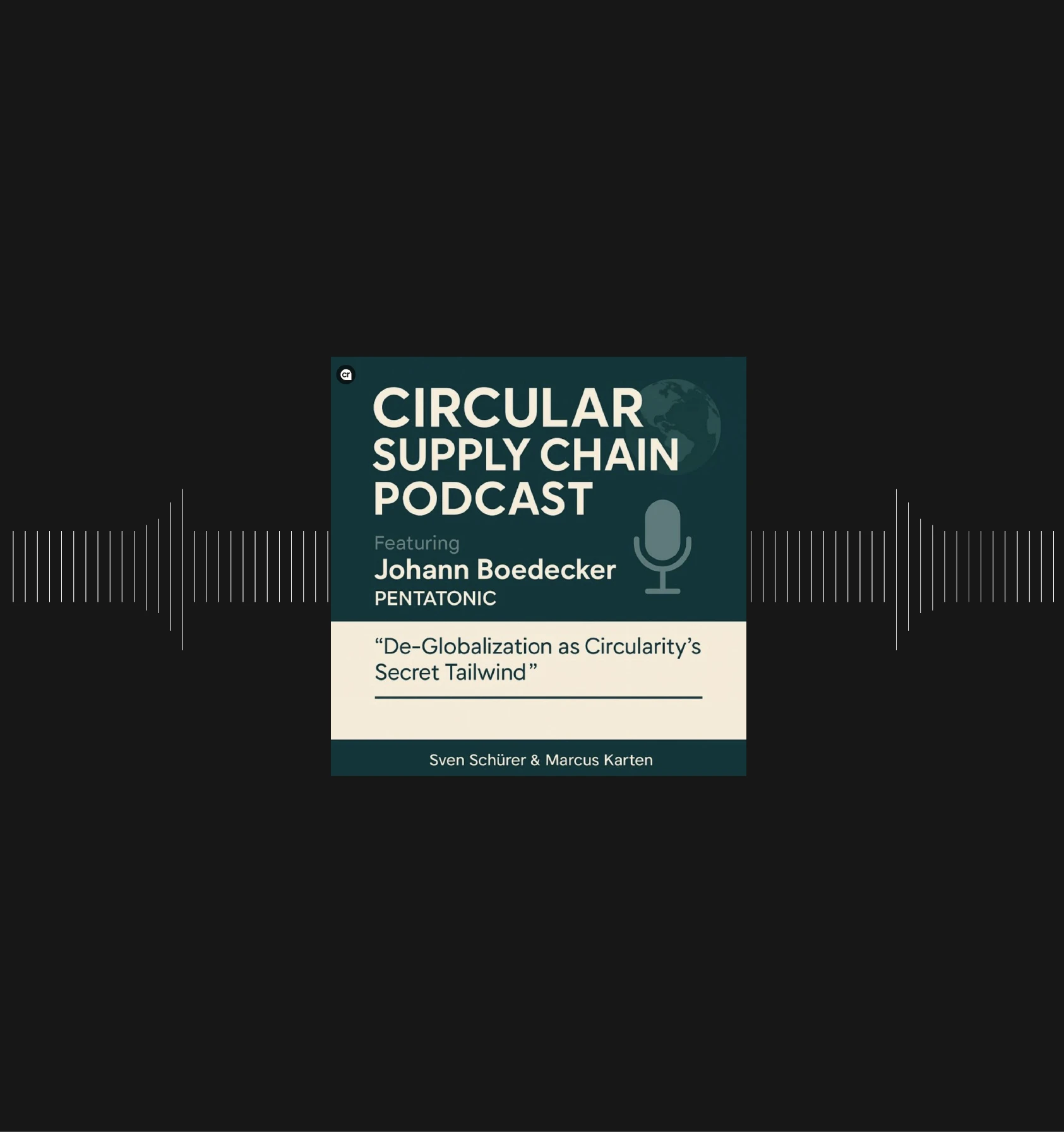
When I started my career in supply chains in 2009, working between Taiwan and China, I assumed that the products around us were built to perfection. I thought every object we touch, from sneakers to smartphones, had been optimised for performance, sustainability, and manufacturability. It did not take long to realize how wrong that assumption was.
Most of what we make and consume could be infinitely better, both functionally and materially, as well as systemically. That realisation set me on a path that led to co-founding Pentatonic. We built the company on the belief that circularity can be profitable, scalable, and immediate if it is designed into the system from the start.
From “Degrowth” to “Up-Technology”
There is a persistent myth in sustainability that progress means doing less: consuming less, producing less, growing less. I do not believe that is the future. We do not need to degrow, we need to up-technology.
By improving the systems and tools that govern how products are made, reused, and reintroduced, we can deliver more joy and utility to consumers while staying within planetary boundaries. Circularity is not a moral trade-off, it is an innovation opportunity.
The Architecture Challenge
Many brands hit the same wall when they attempt circularity. The problem is not ambition, it is architecture.
Too many companies try to design the perfect system upfront, treating circularity like a one-time rollout. That approach almost always fails. Circularity thrives when it is built like software, with feedback loops, network effects, and iterative scaling.
Start small. Pilot fast. Learn in real time. Scale what works organically across your business.
Most importantly, stop thinking of circularity as a cost centre created to satisfy regulators or environmentalists. The moment you treat it as an efficiency driver, it aligns with your commercial goals and becomes unstoppable.
Building Systems Before Materials
At Pentatonic, we have learned that circular commerce succeeds when the system comes first and the materials follow.
We work with global brands to introduce buy-back and take-back programs that allow companies to reconnect with their consumers. Using AI, we instantly assess the condition of returned items, calculate a fair dynamic price, and automatically route each product to its highest-value outcome such as resale, repair, component recovery, or recycling.
This is not just sustainability. It is superior economics. By closing the loop, brands recapture materials, reduce procurement costs, and deepen consumer loyalty. They also gain richer behavioural data than any CRM system could provide.
That is when circularity stops being a sustainability initiative and becomes a competitive advantage.
Breaking Corporate Silos and Cultural Barriers
The biggest challenge in transforming supply chains is not technical, it is human.
Many corporations are siloed. Innovation teams experiment on one side while operations guard legacy systems on the other. My advice to leaders is simple: start with the teams that are most willing to move.
In our experience, U.S. business units often lead with an upside-maximisation mindset rather than a risk-minimisation one. In Europe, by contrast, we often optimise for avoiding mistakes rather than pursuing transformation. But circularity is inherently iterative, and iteration means imperfection. The companies that embrace this mindset will define the next decade.
De-Globalisation, the Unlikely Catalyst
It might sound ironic, but the biggest driver of secondary economies in the coming years will not be climate legislation. It will be de-globalisation.
As nations move to secure sovereign supply chains and reduce dependency on conflict minerals or foreign materials, circular systems suddenly make strategic sense. Re-extracting resources from end-of-life products locally is no longer just sustainable. It is economically and politically essential.
The second-hand market is also tariff-free, margin-rich, and inherently circular. Owning your second-hand ecosystem, rather than outsourcing it, can be one of the most profitable moves a brand makes this decade.
The New Mandate for Supply Chain Leaders
For executives navigating this transformation, there is no perfect timing. Some investments will come too early, others too late. But the direction is clear.
Leaders must balance two horizons: short-term commercial returns through circular systems like Pentatonic’s platform, and long-term resilience through near-shoring, modular manufacturing, and localised recycling infrastructure.
Those who act now will capture both. Those who wait risk being left behind, not just by regulation but by market logic.
The Bottom Line
Circularity is not charity. It is not compliance. It is efficiency, and it is the next great business revolution.
Do it for the planet. Do it for your children. Or do it for your bottom line.
Just do it.
Listen to the full podcast here: https://circularsuppplychain.com/episode/de-globalization-as-circularity-s-secret-tailwind
When I started my career in supply chains in 2009, working between Taiwan and China, I assumed that the products around us were built to perfection. I thought every object we touch, from sneakers to smartphones, had been optimised for performance, sustainability, and manufacturability. It did not take long to realize how wrong that assumption was.
Most of what we make and consume could be infinitely better, both functionally and materially, as well as systemically. That realisation set me on a path that led to co-founding Pentatonic. We built the company on the belief that circularity can be profitable, scalable, and immediate if it is designed into the system from the start.
From “Degrowth” to “Up-Technology”
There is a persistent myth in sustainability that progress means doing less: consuming less, producing less, growing less. I do not believe that is the future. We do not need to degrow, we need to up-technology.
By improving the systems and tools that govern how products are made, reused, and reintroduced, we can deliver more joy and utility to consumers while staying within planetary boundaries. Circularity is not a moral trade-off, it is an innovation opportunity.
The Architecture Challenge
Many brands hit the same wall when they attempt circularity. The problem is not ambition, it is architecture.
Too many companies try to design the perfect system upfront, treating circularity like a one-time rollout. That approach almost always fails. Circularity thrives when it is built like software, with feedback loops, network effects, and iterative scaling.
Start small. Pilot fast. Learn in real time. Scale what works organically across your business.
Most importantly, stop thinking of circularity as a cost centre created to satisfy regulators or environmentalists. The moment you treat it as an efficiency driver, it aligns with your commercial goals and becomes unstoppable.
Building Systems Before Materials
At Pentatonic, we have learned that circular commerce succeeds when the system comes first and the materials follow.
We work with global brands to introduce buy-back and take-back programs that allow companies to reconnect with their consumers. Using AI, we instantly assess the condition of returned items, calculate a fair dynamic price, and automatically route each product to its highest-value outcome such as resale, repair, component recovery, or recycling.
This is not just sustainability. It is superior economics. By closing the loop, brands recapture materials, reduce procurement costs, and deepen consumer loyalty. They also gain richer behavioural data than any CRM system could provide.
That is when circularity stops being a sustainability initiative and becomes a competitive advantage.
Breaking Corporate Silos and Cultural Barriers
The biggest challenge in transforming supply chains is not technical, it is human.
Many corporations are siloed. Innovation teams experiment on one side while operations guard legacy systems on the other. My advice to leaders is simple: start with the teams that are most willing to move.
In our experience, U.S. business units often lead with an upside-maximisation mindset rather than a risk-minimisation one. In Europe, by contrast, we often optimise for avoiding mistakes rather than pursuing transformation. But circularity is inherently iterative, and iteration means imperfection. The companies that embrace this mindset will define the next decade.
De-Globalisation, the Unlikely Catalyst
It might sound ironic, but the biggest driver of secondary economies in the coming years will not be climate legislation. It will be de-globalisation.
As nations move to secure sovereign supply chains and reduce dependency on conflict minerals or foreign materials, circular systems suddenly make strategic sense. Re-extracting resources from end-of-life products locally is no longer just sustainable. It is economically and politically essential.
The second-hand market is also tariff-free, margin-rich, and inherently circular. Owning your second-hand ecosystem, rather than outsourcing it, can be one of the most profitable moves a brand makes this decade.
The New Mandate for Supply Chain Leaders
For executives navigating this transformation, there is no perfect timing. Some investments will come too early, others too late. But the direction is clear.
Leaders must balance two horizons: short-term commercial returns through circular systems like Pentatonic’s platform, and long-term resilience through near-shoring, modular manufacturing, and localised recycling infrastructure.
Those who act now will capture both. Those who wait risk being left behind, not just by regulation but by market logic.
The Bottom Line
Circularity is not charity. It is not compliance. It is efficiency, and it is the next great business revolution.
Do it for the planet. Do it for your children. Or do it for your bottom line.
Just do it.
Listen to the full podcast here: https://circularsuppplychain.com/episode/de-globalization-as-circularity-s-secret-tailwind
About the author
Johann Boedecker is the founder and CEO of Pentatonic, an AI platform that automates trade-in programs and agentic commerce. Prior to founding Pentatonic, Johann garnered a decade of manufacturing and supply-chain experience across Taiwan and China, and published on materials science and industrial systems.

We’d love to show you exactly how our multi-commerce system works.
BOOK A DEMO
We’d love to show you exactly how our multi-commerce system works.
BOOK A DEMO
We’d love to show you exactly how our multi-commerce system works.
BOOK A DEMO
We’d love to show you exactly how our multi-commerce system works.
BOOK A DEMO
27 Downham Road Units 5–6
London, N1 5AA
UK
VAT: GB307379003
2140 S Dupont Highway
Camden, Kent, DE 19934
USA
VAT: GB307379003
GET IN TOUCH
PRIVACY POLICY

27 Downham Road Units 5–6
London, N1 5AA
UK
VAT: GB307379003
2140 S Dupont Highway
Camden, Kent, DE 19934
USA
VAT: GB307379003
GET IN TOUCH
PRIVACY POLICY
27 Downham Road Units 5–6
London, N1 5AA
UK
VAT: GB307379003
2140 S Dupont Highway
Camden, Kent, DE 19934
USA
VAT: GB307379003
GET IN TOUCH
PRIVACY POLICY
27 Downham Road Units 5–6
London, N1 5AA
UK
VAT: GB307379003
2140 s dupont highway
camden, kent, de 19934
Usa
VAT: GB307379003
GET IN TOUCH
PRIVACY POLICY
27 Downham Road Units 5–6
London, N1 5AA
UK
VAT: GB307379003
2140 s dupont highway
camden, kent, de 19934
Usa
VAT: GB307379003
GET IN TOUCH
PRIVACY POLICY